November 10, 2007
Tuesday, November 13, 2007
Poverty has a face


Sunday, November 04, 2007
FAMILY LIFE IN KAKAMEGA
In any event, I was invited to the home of my friend Evelyn Buhenza last night for tea. She lives in a permanent two bedroom house with about 10 or 12 members of her family. The house doesn't have electricity. The kitchen is a small shack behind the house where the mama cooks over a fire and the tradition 3 stones. the goat pen also shares the kitchen. Goat milk is rumored to be very nutritious especially for people with HIV. Their are also some chickens who live in the house with their chicks so that they are out of weather and more likely to survive. Evelyn is my friend who is HIV positive and has herpes xoster which is a large brown growth on the left side of her face. It is painful, it semi paralyzes her face and she has lost all of her teeth on the left side as a result of it. She is taking ARV which is very successful in keeping the virus from progressing However there are side effects like the stomach ulcers she has.
Evelyn has been lucky that her family has welcomed her back after her husband died of AIDS and she tested positive. The stigma is so high here that most HIV positive people are left to manage on their on. However, Evelyn has joined another woman here who has publicly acknowleged that they are HIV positive and have become active advocates for overcoming stigma and inspiring other HIV positive people to seek ARV treatment and to find ways to live positively while looking toward the future. As many of you know, Evelyn has returned to school to get a degree in social services and i have raised a small amount of money from people in Chico to assist her with the tuition. I really respect and admire her and am happy to be able to support her work. She has told me that when she tested positive she felt like she has received a death sentence and that her family felt like they were living with a dead person. But now she has so many opportunities and is so enthusiastic about her work and her goals for the future.
My greyness disappeared after meeting with her at her school this morning. She has to be extremely brave because as we walked down the street, people openly stared at her and her face. I am uncomfortable being stared out because I am white, but people here believe that a person with HIV has somehow done something immoral so her reception is for the most part very distant. I've realized how far we've come in the US since the Ryan White case.
She is also one of the rare women feminists in Kakamega. Women have traditionally held an inferior position here. Sincerely their only option was to get married early so that they did not remain a burden to her parents. The Luyha tribe, where I live, still pay dowries. Funny enough, when people die here they are buried in the family plot inside the shamba or boma. But if a woman dies without getting married and her husband dies and she doesn't remarry, she is buried outside the boma, usually at a place far away. She was also telling me about women and children outside of marriage. It's required that the woman name a father on the a birth certificate. If she doesn't know the father, she is forced to name someone. Then , the man's parents are entitled to come and take the child to raise. However, if the family doesn't believe the man is actually the father, they will take the child but most likely the child won't survive.
Those sound like terrible stories, but ultimately, it is all about a scarcity of resources. People do what they have to do to survive and to keep their families going. These are such hard concepts for me to understand and I try my best to not make any judgements because, I have never been faced with those choices. I imagine it will take more than one or two generations to make the changes that Evelyn and those few other women are stuggling for.
Saturday, November 03, 2007
POLITICS IN KENYA
Kenya gained indepence from the British in 1963, so they haven't been participating in government for very long. It is unbelievably interesting to watch the process that we must have gone through a couple of hundred years ago. The first president was kenyatta, he was highly respected and got the country off to a good start. Then, in 1981, i think, Daniel Arape Moi took power and ruled until 5 years ago. Moi was totally corrupt and almost bankrupted the country while doing nothing for the people. He neglected all the infrastructure so badly that i think it will take 20 years for Kenya to catch up, even under the assumption that the government will honestly allocate money for the projects. The worst and biggest hurdles to economic development is the roads. The roads make it almost impossible to get raw materials to and from places and to get finished goods to market. The other day I took a matatu to a town called Kericho, which is the tea capital of the country. The road was so bad that the cars have simply driven off the side of the road and made a new dirt road. it was literally four wheel driving the whole way. and of course, the driver drove mostly 80 miles an hour except for the really bad potholes. as we say, any day you get somewhere safely in the matatu is a good day.
anyway, all the politicians(they are called aspirants) who are running for office are now campaigning around the country and the people are talking about nothing except the elections. It is Kibaki(a kikuyu) against Raila Odinga(a luo). Kibaki is for the status quo, which is to keep all power in Nairobi and manage in a top down approach. Raila is supporting a radical idea which is to transfer power to the provinces and let them decide how to use their taxes and natural resources best. Unfortunately, the majority of the people in the rural areas are not well educated about government and are easily swayed by who gives the best t-shirt at the rally. in addition, no matter who gets elected, managing resources in kenya is all about taking care of your own. first priority is your extended family, then your tribe, then your community. It has been that way for hundreds of generations and i sincerely don't know if it will ever change. i think there is a growing population of young people who would like to see change, but they are swimming against the current.
Yesterday at the Golf Hotel, one of the "American" hotels in town there was a big rally. i was eating lunch there and watching the dynamics of the goings on. There were quite a few well dressed men who exuded an air of importance who i took to be the candidates and their staff. Their was a canopy set up on the lawn and all the seats there were filled with men. There interstingly enough, a section of chairs outside the tent where the women sat. The rally started with a long prayer and then, the women did some sort of welcoming song for the cadidate. After that, it was a speech that could be heard by any candidate in any country.
However, in spite of the exclusion of the women by the general audience, there are several women who are running for office all over Kenya. The unfortunate thing is that, every day in the newspaper, there are stories about those women getting beaten up. It is condemned by the press, but of course, the people in the rural areas who are participating in this do not frequently read the papers. it is definitely a slow going and painful process of political reform.
I wish I was going to be here for the elections which are held in December. The energy of the town has really picked up with all the activity and i imagine things will really start to get interesting. My prediction is that Kibaki will triumph. In my experience, Kenyans are slow to accept change and prefer to hope that the current situation will improve, rather than risk the unknown.
Monday, October 29, 2007
My Humble Abode


Saturday, October 27, 2007
Settling In
10/21/07
I am sitting watching the sun set over Lake Victoria in the city of
On the way from Kakamega we passed two stacks of plastic green lawn chairs just sitting by the road. When I see odd things like that, which is pretty often, I always wonder about the story behind it. I came in the taxi of my friend Maloba. He is a very safe driver although the roads are literally bombed with potholes; I don’t know how their cars stay in one piece. Actually, when we got to Kisumu, Maloba’s car began having problems with the idle and it totally died every time we slowed down. We solved the problem by recruiting a couple of guys every time it stopped to give us a push so he could jump start it. Flexibility is the strength of Kenyans.
In pursuit of implementing our girls’ empowerment project, I chatted with six high school girls to get their input and ideas. Initially they were very shy, but after devouring chicken and fries, they were surprisingly open. When I asked them about what kind of topics would be interested in discussing during the meetings that are a part of the program, they gave answers like abortion, coping with stress, learning how to care for an HIV patient who was ill, and how to overcome and live with the stigma that always accompanies having a parent who is HIV positive. The typical day for these girls are to get up at 5 am and prepare some sort of food, get ready for school and depart for school at 7 am, go to school until 5 pm, travel back home for one hour, do all the household chores and complete their homework. It is staggering to think of what is expected of 15 and 16 year old girls. They also wanted some advice on how to improve their concentration in class.
Not all students in
The students sit for exams again after they complete the 12th grade, and currently because there are so many students and not enough facilities, the universities are only accepting students who score and A- or higher. Even if the student qualifies for university, it requires a bribe of about $2000 for the student to be considered for acceptance.
According to the papers, the college admission board one of the top three most corrupt institutions in
I also attended a meeting of the group of microfinance entrepreneurs that have come together to form a coalition with the intent of strengthening their businesses as a collective. The seriousness of the members is astounding. They have formed a registered community based organization, elected officer and adopted a constitution. The constitution outlines fines for lateness to meetings, excused absences and unexcused absences and expulsion of a member who does not regularly attend. The meetings are conducted by Roberts rules of order, except for the prayer part. Prayer is a major part of all gatherings, public or family and these people are expert prayers. There is a prayer to the opening of the meeting, before we eat our snack, and at the close of our meeting. I would guess that the praying took up about 20 minutes of the meeting. They have a strong faith in the goodness of God and rely on prayer to bond them together as a community. I am just praying they don’t ever call on me to lead the prayer….
The chairlady of the group had just experienced some bad luck. She had purchased a tree and paid someone to turn in into lumber for her, using a borrowed chain saw. Apparently, someone had been watching the goings on, and in the night, came to the house where the wood was waiting to be hauled away and stole the lumber, the chain saw and the truck being used to haul the wood. They also beat up the owner of the house so badly that he is in the hospital. She had borrowed money to buy the tree, which she could have easily paid back after the sale of the lumber, but now she has no means to repay the loan. This is a story I hear repeatedly in
Wednesday, October 17, 2007
I AM HAPPY TO BE BACK
However, cold water is not part of the deal. There is a low pressure shower head, but taking a cold shower requires bracing myself. For shower shoes, they provide a pair of mismatched blue and red thongs(flip flops, not underwear)
I've seen so many people I know and they once again have been very welcoming. I have discovered if I walk at a slow leisurely pace people assume I am more of a mzungu resident than occasional visitor, plus by slowing down I recognize people I know and can be more friendly. Africans always have that stone face, but if you greet them with a smile, they bloom into really friendly people. They just look intimidating.
I am surprised how my swahili is coming back. It seems like it needs to simmer in my head during the times I am at home, and then it is there to use when I am here. The maid at the hotel doesn't speak English so I am truly forced to speak swahili, rather than be lazy and speak English. It helps that she is very patient. Children are also good to practice on.
It must be the rainy season. It has been pouring cats and dogs most days. That makes it a little more difficult to get around. Even an umbrella doesn't really help, the wind blows the rain sideways. Apparently it is not really mosquito season though and no malaria is going around, so I am keeping my fingers crossed that my malaria medicine is effective and I am going to skip that part this time.
Everyone is focused on politics right now. The presidential election is in December. The present president Kibaki is running again and another guy named Raila. The race is really against a Kikuya(Kibaki) and a Luo(Raila). Those are the two biggest tribes in Kenya. The other remaining 40 tribes are in the process of lining up with their preferred candidate. Most tribes traditionally like or dislike the one of the tribes represented, so rather than voting on an issue basis, they vote for the preferred tribe. I guess that is really not so different than the US. The Luhya, the tribe I live with, hate the Kikuyu, so they are Raila all the way. Also, there is alot of news in the paper right now of election corruption and buying votes, which is very effective for people who only eat one meal a day.
Saturday, May 19, 2007
The First Normal Week
The purpose of Alicia's trip was to visit several of the organizations that interns of FSD have worked with in the past. One of them is a center for handicapped children. The headmaster is great, very well educated and knowledgeable about children with special needs. In Kenya, children with special needs are thought to be sent by God to punish someone's bad acts. As a result, most children are hidden in the house or actually tied behind the house like an animal. The Center does outreach to identify and bring these children to live at the school. They seem to thrive in this environment but still it tugs at my heart to see how tough their lives are.
On a separate day, we visited shikokho high school and delivered the soccer socks and shoes. Last year, thanks to the Chico State Women's team we were able to deliver uniforms and several pair of shoes. Even though the girls team is only 6 years old, they performed very well at the district tournament last year. Believe it or not, the village of Shikokho just got electricity and they already have a computer lab that is serviced by high speed internet. It is so great, it really connects the high school students to the world. Another neat thing that has happened here is that it is possible to get internet through your phone, so our program director Peter actually can work on the internet at his house which doesn't have electricity. Thank God for Alexander Graham Bell.
After that we went to a women's group in Malinya. They are a group of widows who are hiv postive but have come together to support each other and to do community work. They met us at the gate dressed in their lavendar sateen dresses and sang and trilled to welcome us.
They also presented us with strings of tinsel as a kind of a hawiian lei. We did all the formalities and then they fed us dinner, ugali, kale, cabbage and chicken. It rained heavy in the afternoon so it was very dark in the house while we were eating, but really i can't imagine a nicer experience. I worked with some of the women at k-rep and they were very welcoming. I have seen so many people i know here, I hadn't realized how many people i had gotten acquainted with. It is a wonderful second home.
I haven't had water in my house for several days so I have come to town to buy a jerry can and water. It is so funny that in Kakamega where it rains every single day that the water is so inconsistent. People here are so accustomed to adjusting to whatever circumstances happen.
Monday, May 14, 2007
I am not in Kansas any more
People here have been more than wonderful in welcoming me back. Because I am an older white woman, which is a very rare species here, people tend to recognize me and are surprised to see that I have returned. In the next few weeks I will have a chance to visit some of the microfinance groups I worked with before and that will be great. However, I anticipate some tough times too, since many of the people had Aids and there is a distinct possibility that some may have died. I did get a chance to see one woman from the groups, who had shared her story with me last year. She is in the advance stages of AIDS and has herpesxoster on the left side of her face. This condition is like a big dark mole or wart that is progressive and actually debilitates the nerves on that side of her face. In any event, not only is having the medical problems difficult, having this disease is like wearing a scarlet A for aids. She shared with me that not only is her farming business going well, she has become certified for HIV testing and counseling as well. I am really impressed with that because so few people here with are willing to be an AIDS victim in public, instead they remain secluded until they die.
I saw our adopted children, Faith and Junior. I actually live on the same lane again, only a little further down the way. They were very cute, yelling mama Nette, mama Nette. When I picked junior up he told me in kiswahili that he is reading. They seem to love school and all the extended family is very buoyed up by the fact that they are going to school. They do have a new little brother named Peter. The guy who helps me by paying the school fees and buying the uniforms is named Peter and he is really thrilled to have a namesake. In any event, I can see that I may have to go back to work to support more than a couple of kids! There are so many children here that could use our support. While I am here I will be taking some picture and videos of children that would benefit from some support and I will share those with you when I get home.
The people I will be working with here are Peter Ingosi, the man I knew last year, and a young woman from Florida named Lillian. She is an old pro, she has been here since August. Our first group of new interns arrives on June 3rd so we are busy planning the orientation week for them. Currently, there are four interns here. This weekend we made a trip to the Kakamega Forest and spent the night. On Sunday morning, we started a hike at 4:45 am and ended up on a hill watching the sun rise over the rain forest. It was beautiful, the mist was hanging low, all the birds were making a raquet and you could hear the colobus monkeys call all around the forest. On the return trip, we actually spotted a gaboon viper crossing in the trees above us. Thank god it was little and didn't seem as dangerous as a big one would have. I still had the creeps.
We are cramming into a matatu this morning and heading to the big city of Kisumu to do some errands. Then I will know I am back, hot, crowded and dangerous. Africa in a nutshell.
Friday, October 20, 2006


final chapter in kakamega
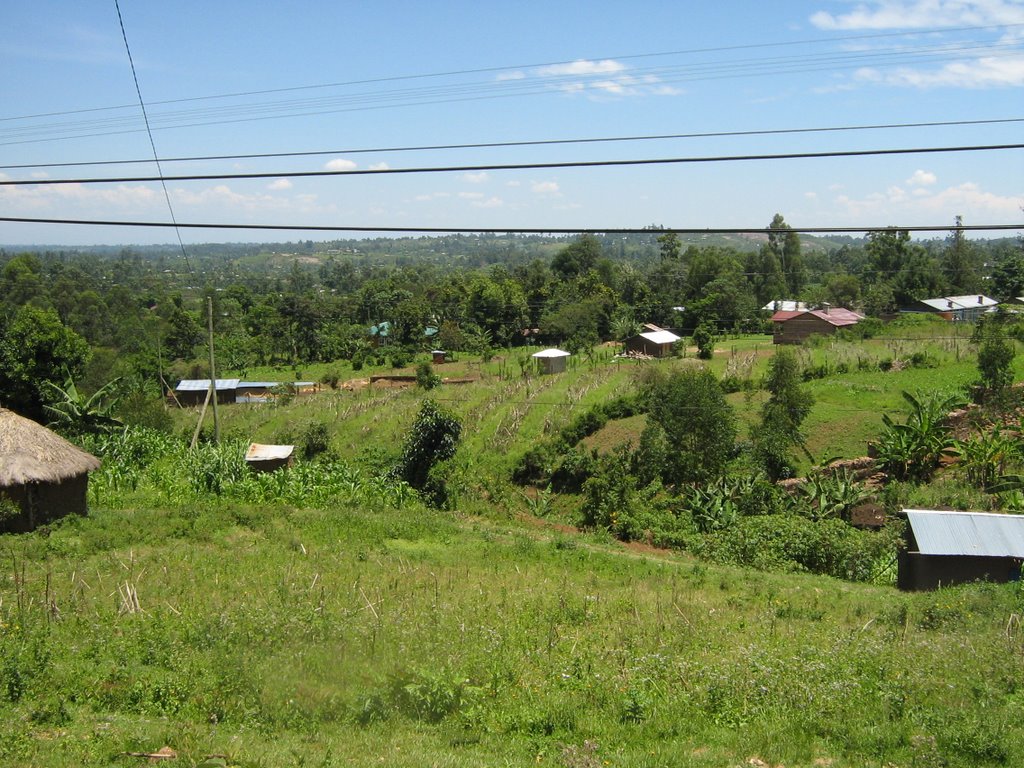
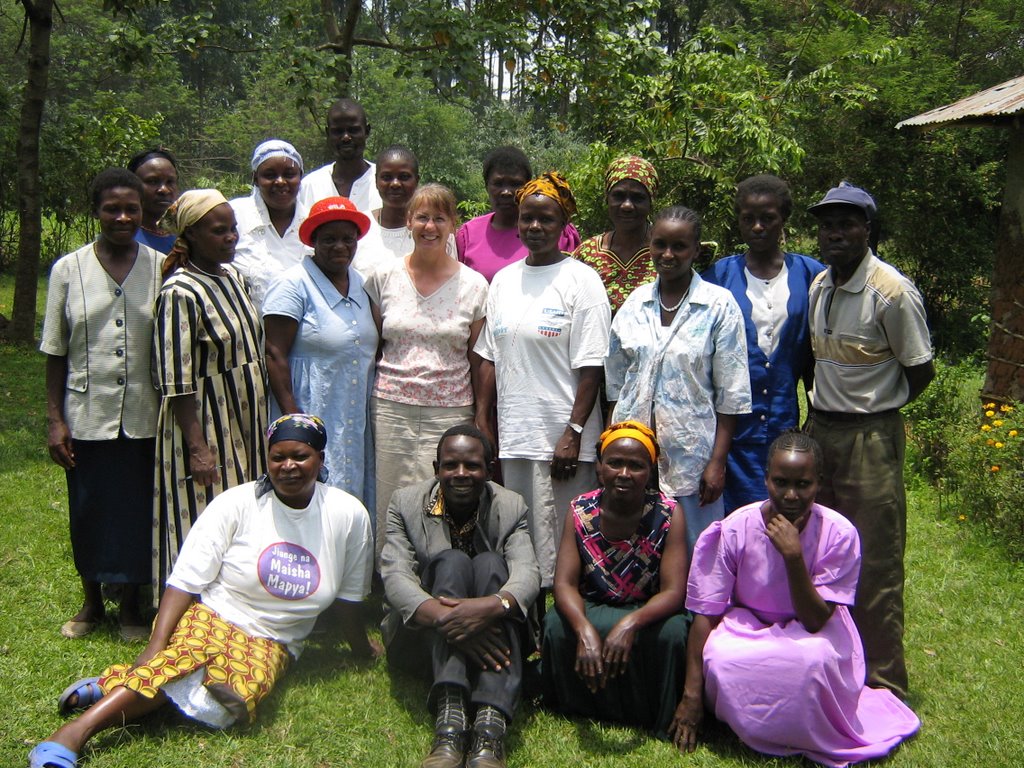
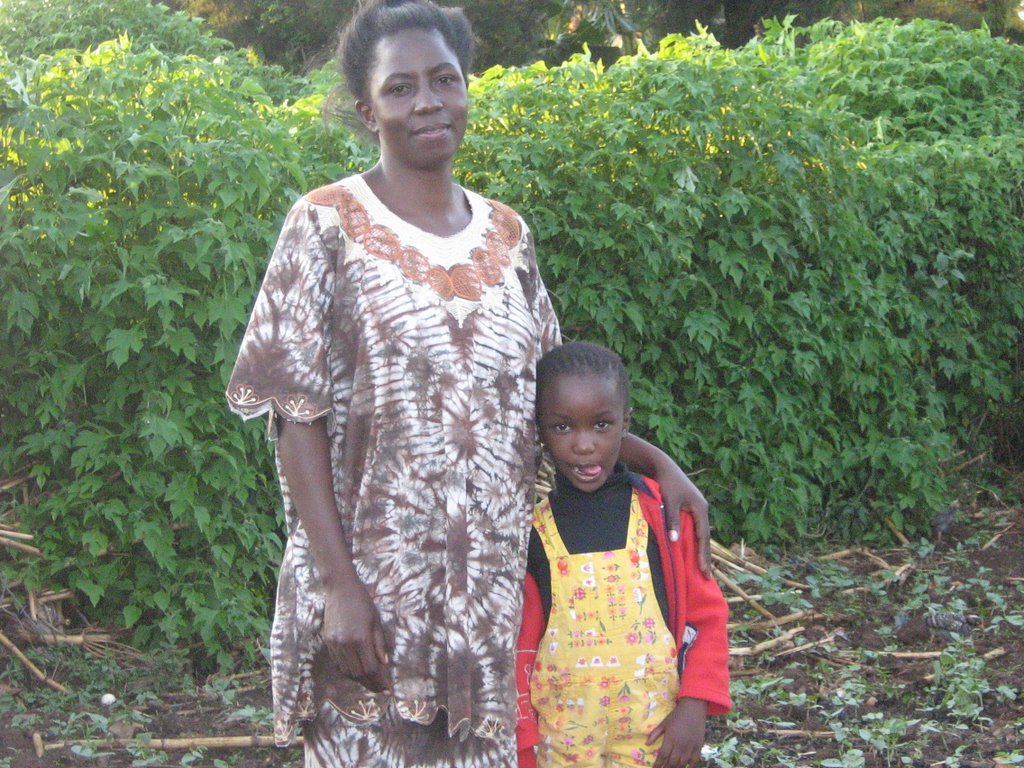
By interviewing clients for this video, one of the bonuses was getting to know them so much better. One of the women who started from absolutely zero and now owns several successful businesses was very inspiring. She has publicly acknowledged that she is HIV positive which is a rare and brave action. She told me that she choose to go public because in reality most people around her already knew and everyone spent quite a bit of time whispering about it, so by acknowledging it, she stole the gossip back from them. Now, she calls herself an ambassador for hope for people with HIV. Her story about HIV is so typical of many of the women I got to know in Kenya. She and her husband were living in Nairobi, he died and she found out that she was HIV positive. As a widow and HIV victim, she lost everything, even the support of her family, even though being positive was not her fault. So, with one child, she moved back to Kakamega and started participating in the FAHIDA micro credit program and really empowered herself. Another women with a similar story invited me to her home for tea one evening. She and her 9 year old daughter live in one room about 10 feet by 20 feet. There is a curtain hanging accross the middle of the room to separate the bed from the living area. She was so welcoming to me, we had chai, boiled yams and boiled sweet potatoes which we ate by latern light. I know that everyone in Kenya struggles in the same way, but I was always so touched at how people made the absolute best of their situation and seemed to be happy in spite of it. That is a story that I witnessed time after time in Kakamega and it has made me think so hard about our lives here in the US. But that is a whole nother blog entry!
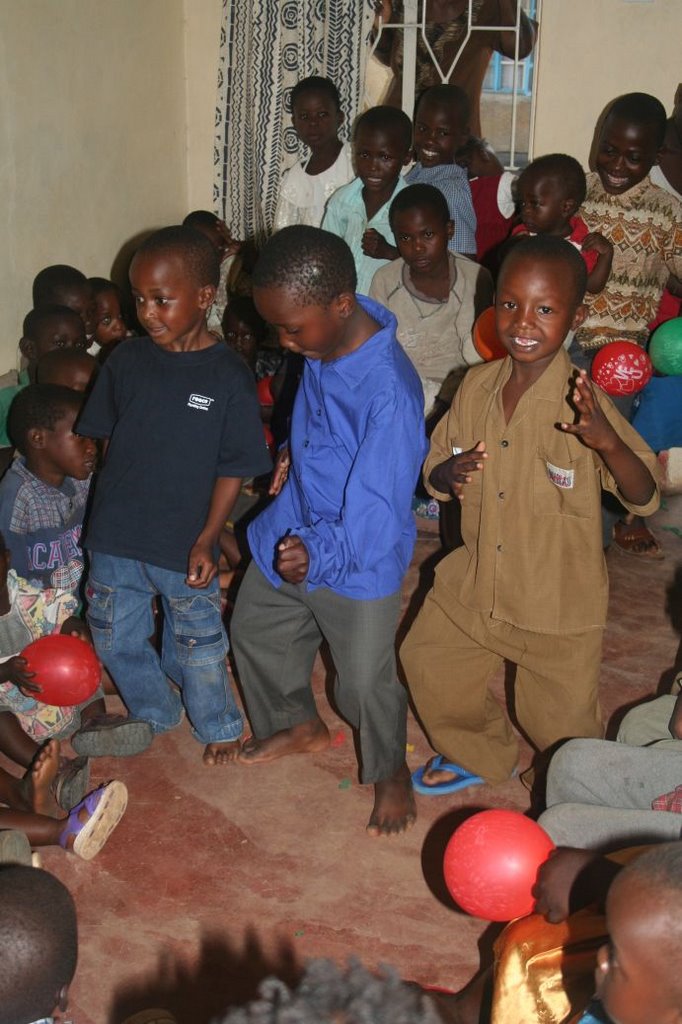
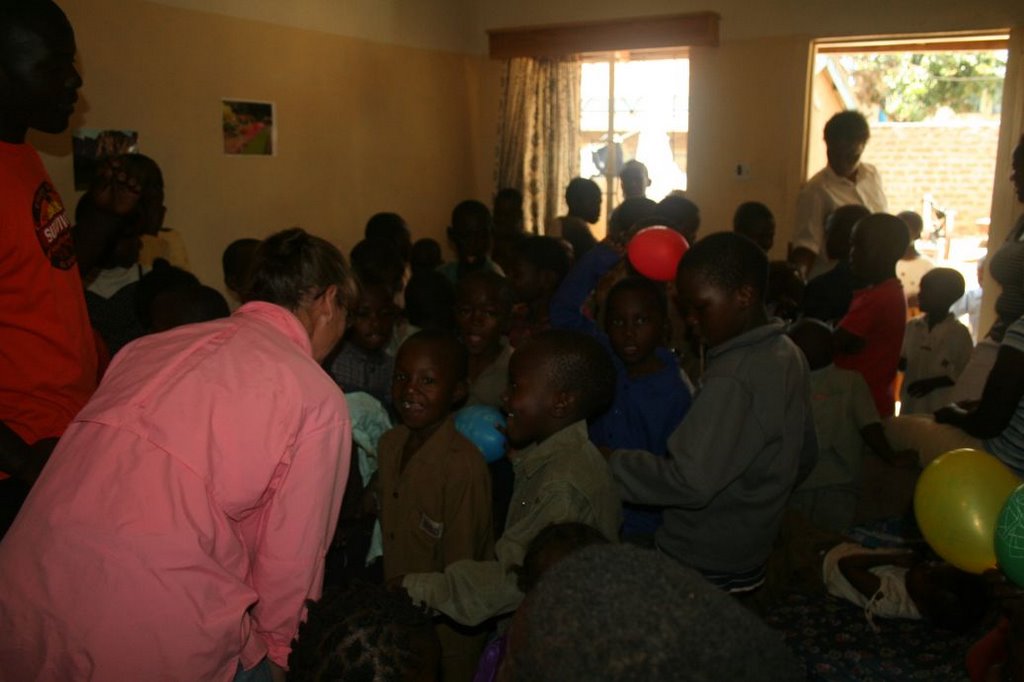
One of the final highlights of stay before I left was that I gave a small party for 56 of the neighborhood children. The children who lived on my lane and in my neighborhood gave me so much happiness. When I came home after work and walked down the lane to my house, all the little kids waited by their houses to come out and greet me every night. One of them would see me coming and shout for all the other kids to come say hi to the muzungu. I was teaching them to say howdy and give me five. It literally took me 30 minutes to walk home since I stopped so many times to say hi. My favortie group of kids lived near me and I have already put their picture on the blog. Their names were junior, faith and cecilia. They all wanted to be picked up and hugged when I came by, and sometimes they were pretty dirty and without any pants, so i just hoped mommie had wiped their bottoms good when I picked them up. Anyway, one Friday night, Andrew Lutomia and I visited all the houses in the neighborhood and invited the kids to come, which they did precisely at 10:00 the next morning, all dressed in their best clothes. We had balloons and dance contests first. They also did some reciting while we took video. Then, we gave out little boxes of crayons and books so they could color. and finally little packs of cookies and juice. I think they all had a great time, Andrew assured me that they had and that undoubtedly not one of them had ever been to a party or gotten free gifts before and that they would probably remember this party for the rest of their lives. It seemed so little compared to what we shower our children with on holidays and birthdays. I really loved having all those kids around. For a few days on the lane, some of the older mamas would stop me and tell me how happy the kids had been at the party.
Here are some of the things I will miss about my Kakamega. I will miss my boda boda driver named Francis who has a degree in Philosophy and tutored me in Kiswahili while we rode to work. I will miss my Muslim friend reading the morning paper on the corner by my work who went out of his way to greet me every morning. I will miss my work partner at K REP, Benard who shared so many insights with me about Kenyan people and the culture. I will miss a little taking a bath in 3 inches of water in a plastic basin and the lizards that lived in my bathroom. I will miss paying 5 cents for a huge avacado. I will not miss ugali and kale. I will miss speaking Kiswahili and having the old mamas laugh when I spoke Kiluhya to them. I will miss the all the dogs in the neighborhood howling at the moon at night. I will not miss the unbelievably horrid bumpy, potholey roads. I mostly will miss the simplicity of life and the contentment that comes with knowing that your only choice is to find a way to cope with everything and the true realization that ultimately, none of us really control anything.
Monday, September 18, 2006
travel in kenya
9/18/06
What a trip to the town of
I was accompanied by my young neighbor Andrew. He is typical of almost all Kenyans, except for going to
The next day, we took another taxi to
Tuesday, September 12, 2006
My time is speeding by in Kakamega. Once again, now that I have returned, people have begun to trust me and open up and I have learned a great deal about Kenyan culture. Today I learned that Kenyans work very hard to avoid confrontation. I believe this is because they are such a close knit society and conflict between people disrupts the entire group. Therefore, there is a lot of pressure for people to resolve conflicts in a different way. The most common way to deal with conflict is to use very diplomatic language to create a situation in which there is no chance for a conflict to arise. I have encountered this method while dealing with people here but have a difficult time understanding because they use a lot of underlying innuendo to convey the message and I know I am quite often missing the point.
Another thing I have discovered is that Kenyans rely on formally organized groups to form bonds outside of their family and neighborhood and they believe strongly in the power of groups to educate and to empower people as well. Being unoccupied in Kenyan is really looked down on, those people are called “idlers.” Therefore, by participating in a group and making an effort to better yourself and your situation is seen as a good alternative to being idle. It seems that the goal of many of the groups is to work on ways to improve their communities. One of the youth groups that my young neighbor belongs to is in the process of finding ways to recycle plastic bottles and bags. Oh, by the way, I mentioned before that I was tutoring Andrew in a few subjects while I am here and now I am also teaching him dog training as well. Of course I am the expert because A) I am crazy about dogs and B) I watch the Dog Whisperer regularly on TV. Anyway, Andrew is very entrepreneurial and sees dog training as maybe being a lucrative business in
The worst crime you can commit in
Finally, everyday I see many things that just make me sad. On the boda boda ride on the way to work every morning, I pass a vacant lot near downtown Kakamega where several men in very ragged clothes are sitting around a fire. It is the official place for homeless men to congregate during the night. There is a lot of garbage dumped near there and I usually see a couple of guys picking through the garbage. When you pass by during the daytime, you see lots of old worn out coats that are hung all over the signs. These are the coats that these men use to keep warm at night. Yesterday I saw an old man hobbling down the street without any shoes, which is not that unusual here. But the awful thing is that his feet were swollen to about 3 times the normal size and looked unbelievably painful. And today at the hospital, there was a naked woman with just a blanket wrapped around her waist, walking on the hospital path shouting incoherently while people just passed by without taking much notice of her. So many times here I have heard the comment from people that unless a sick person has the money for medical treatment, they are just left to die like an animal. Can you imagine such a place existing in this day and age where resources are so scarce that no resources are “wasted” on the sick and the weak. The best word I can use to describe what I experience in
Saturday, September 09, 2006
In pursuit of producing my DVD, I spend today talking to a couple of my clients who may be participants in the video. It was wonderful to learn about how entrepreneurial these two people had been and how they had been able to take a very small loan of about $125 and use it to create fairly profitable businesses. One man that I talked to had decided after working for a woman’s grocery business for a while, that he would never make enough money working there to be able to get married and have a family. And even thought he was making peanuts, he was able to save enough money to buy a boda boda and operate it to increase what he was making. After that, he started participating in the FAHIDA program and using the loan proceeds from that program, he started a small kiosk near a school where he sells items to the school kids. It has been highly profitable for him and he makes enough money now to send his son to private school. He has used some of his profit from the business to get a drivers license and now he is in the process of saving enough money to buy a used car and start a taxi business, which he says is really needed in the area. That way his wife can run the kiosk and he can do the taxi driving at night and they will make a very good living.
My woman client is a sort of personal shopper. She gets her clients from the university, professional people like magistrates and lawyers, and the government offices where people make the most money in Kakamega. What she does is to take notice of what kind of clothes and styles those people wear and when she goes to Uganda to buy the mitumba, she finds quality clothes that those people will buy. Once she gets the clients, they actually begin ordering specific things from her as well. She has done very well because she is able to charge a good price without people trying to bargain with her and in essence they pay her for shopping for them. It is a very unique concept in Kakamega and I am really impressed by her business savvy.
I also talked to one other women who my colleague Benard suggested I talk to because she has been really excellent at paying back several loans and is currently paying on a loan of about $800 which is a considerable sum in Kakamega. Come to find out, as she very matter of factly told me, she is not running a conventional business. In her words, “she has been a hooker throughout” and she has been paying back the loan from the proceeds of that business. I think Benard was a little surprised when I told him that. However, she assured me she is planning to open a boutique at some point! She was really down to earth and funny and I really had fun talking to her.
Once again, when I arrive at the groups we are servicing, the people are unbelievable friendly in welcoming me back, to the extent that since they knew I had been sick, they have been praying for me.
return to Kenya
I hopped my way across the world from Dallas to Chicago to London to Nairobi to stay for my second night in Kenya in the city of Kisumu. A stop in Kisumu is almost always mandatory because of the mega Nakumat supermarket there. The choices include many western products and make eating in Africa a more interesting adventure. Rather than the hospital, I stayed at the Sunset Hotel and had a beautiful room with a balcony right on Lake Victoria, in a quiet part of town called Milimani.
My little house was just as I left it, literally, including food we had left in the fridge for over a month! Like a mother hen, I was overcome with the urge to clean and put my own smells in the place. This time, I brought several photos and things to decorate the walls so I have been able to make it a very comfortable home. But because this is Africa, I currently don’t have running water and the fridge doesn’t work. Oh well.
Sunday night, the Lutomia’s, my landlord, invited me to a family supper. One of their sons is married to a girl from Boston. She and the son met only briefly when he was visiting the US. They carried on a long distance relationship and got married. She continues to live in Boston and he lives in Nairobi. It must make for an interesting marriage. Anyway, dinner was served in the living room and was chicken, cabbage soup and chapatis. The TV was on with the volume turned pretty loud as it often the case in Kenyan homes, but it made it hard for me to carry on a conversation with someone across the room. I am having to get accustomed again to understanding their accent. We watched a Mexican soap opera dubbed in English while we ate. The soap opera was really dramatic with many diabolical characters and everyone really enjoyed following the intrigue. It was so nice to be included in their family. It is certainly not a daily situation that exists at home.
It was very nice to come to work on Monday and I got a wonderful warm welcome back from everyone at my office. Many people on the lane where I lived recognized me from before and were friendly. I have gotten the go ahead from the KREP head office for the DVD project that I am so excited to complete while I am here, but was informed that there aren’t any USAID donor funds earmarked for asset purchases. So this is my official plea for donations to my project if anyone is interested. Donations will of course be tax deductible. You can mail or give the money to Bob and he’ll put it in my account and I assure you, in spite of all the corruption in Kenya, I promise to use the money for which it is intended! The project I am working on is producing a business training course using a DVD. I will be using Kenyan business people who have successfully started businesses using KREP loans and interviewing them to illustrate certain business concepts we are trying to teach. I think the DVD will be very interesting to the students because it will be in Kiswahili and will feature fellow borrowers who have actually used the business concepts we are teaching to solve problems in their business. The DVD will be used as an introduction to the concept, and then the trainer can pause the DVD and expand on the concepts and do practical exercises with the students. I am really excited about the concept and it is really challenging to make it all come together like I am envisioning. I feel like it is so serendipitous that I came to Kenya and ended up working in an area. where I can use my experience from the US to perhaps make a contribution. So the above mentioned donations will be used for a TV, DVD player, a TV stand and some other classroom equipment like a chart easel and whiteboard.
So as the day went by on Monday and I did my usual routine I saw many people I had become acquainted with and everyone was so nice about welcoming me back. The young girl from the bookstore where I shop invited me to lunch and told me all about her upcoming marriage. Notice I said marriage, not wedding. When people get married in Kenya, the man has to pay a dowry for the woman and pay for the wedding so it is very expensive. So as a result, most couple only have family present while the priest marries them and then if they can afford it, will have a celebration later.
On Monday evening, one of the sons from where I live came to visit. He is a guy in his early twenties and shared with me that he had spent the last several years living in Uganda, hanging with a bad crowd and partying all the time. He has now decided to get his life straight so he has returned to Kakamega to continue his education. However, because he wasn’t serious about school before, he does not have a good education and has asked me to tutor him in several subjects, including computer, French and English. So, I guess I will be spending a few hours a week with him teaching him what I can. He’s a good kid and I kind of hope maybe spending some time with him can encourage him to keep going this direction. You know, at the risk of sounding like a bleeding heart liberal(which I most likely am) I am glad of the chance to be here and to be able to find so many ways to give back to people. As many of you know, my personal philosophy is that our true obligation in life is to generate positive energy or whatever you want to call it to give to the world while we are here and I feel fortunate that I am able to accomplish a small part of that while living in Kakamega. By the way, did you know that Kenyan salt is not as salty and Kenyan sugar is not as sweet? It’s a mystery to me.
Friday, August 11, 2006
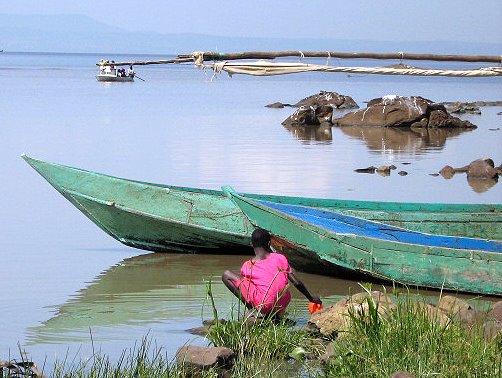 here is a view of one of the bays in lake victoria. it is such a huge lake that you can only see a tiny portion of it standing on the bank. the dhows on the bank are still used by fishermen who fish for tilapia, which is abundant in the lake and one of the main foods in this area. lake victoria is only about 60 miles south of where i lived in kakamega.