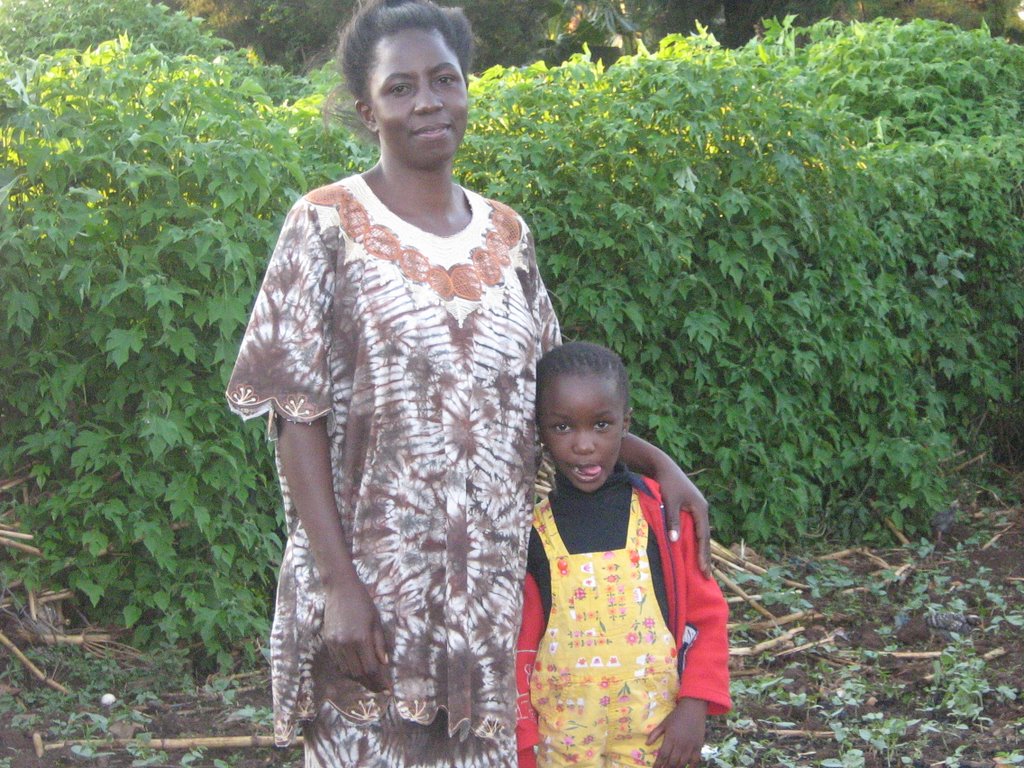
 this is my friend and client named melbarkley. she is hiv positive and a single mom.
Friday, October 20, 2006


final chapter in kakamega
I left Kakamega on Friday, October 6th. The six weeks that I stayed in Kakamega this time went so darn quickly. I stayed really focused on work while I was here. For me, the work was incredibly rewarding and I felt like I was really doing valuable work and making a positive contribution. Working on a volunteer basis for no pay is a wonderful experience because I was no longer relying on how much money I was making to determine the worth of my efforts. Instead, my connection to the people I was working with and their feedback were all that I needed to feel happy about working. I managed to video about 8 clients and their businesses for my training DVD project and both Bob and I are really looking forward to the challenge of creating it now. I also was able to complete the framework for the training manuals and I arranged to set up a classroom as planned in the Kakamega office. Both the program director and the managing director in Nairobi were very happy to add these tools to their program and I think we all feel that implementing an effective training program for our clients will not only give them the direction the need to make their businesses successful, but also to add to the quality of their life with education as well. Anyway, time will tell if that is true or just a hopeful fantasy!
By interviewing clients for this video, one of the bonuses was getting to know them so much better. One of the women who started from absolutely zero and now owns several successful businesses was very inspiring. She has publicly acknowledged that she is HIV positive which is a rare and brave action. She told me that she choose to go public because in reality most people around her already knew and everyone spent quite a bit of time whispering about it, so by acknowledging it, she stole the gossip back from them. Now, she calls herself an ambassador for hope for people with HIV. Her story about HIV is so typical of many of the women I got to know in Kenya. She and her husband were living in Nairobi, he died and she found out that she was HIV positive. As a widow and HIV victim, she lost everything, even the support of her family, even though being positive was not her fault. So, with one child, she moved back to Kakamega and started participating in the FAHIDA micro credit program and really empowered herself. Another women with a similar story invited me to her home for tea one evening. She and her 9 year old daughter live in one room about 10 feet by 20 feet. There is a curtain hanging accross the middle of the room to separate the bed from the living area. She was so welcoming to me, we had chai, boiled yams and boiled sweet potatoes which we ate by latern light. I know that everyone in Kenya struggles in the same way, but I was always so touched at how people made the absolute best of their situation and seemed to be happy in spite of it. That is a story that I witnessed time after time in Kakamega and it has made me think so hard about our lives here in the US. But that is a whole nother blog entry!
One of the final highlights of stay before I left was that I gave a small party for 56 of the neighborhood children. The children who lived on my lane and in my neighborhood gave me so much happiness. When I came home after work and walked down the lane to my house, all the little kids waited by their houses to come out and greet me every night. One of them would see me coming and shout for all the other kids to come say hi to the muzungu. I was teaching them to say howdy and give me five. It literally took me 30 minutes to walk home since I stopped so many times to say hi. My favortie group of kids lived near me and I have already put their picture on the blog. Their names were junior, faith and cecilia. They all wanted to be picked up and hugged when I came by, and sometimes they were pretty dirty and without any pants, so i just hoped mommie had wiped their bottoms good when I picked them up. Anyway, one Friday night, Andrew Lutomia and I visited all the houses in the neighborhood and invited the kids to come, which they did precisely at 10:00 the next morning, all dressed in their best clothes. We had balloons and dance contests first. They also did some reciting while we took video. Then, we gave out little boxes of crayons and books so they could color. and finally little packs of cookies and juice. I think they all had a great time, Andrew assured me that they had and that undoubtedly not one of them had ever been to a party or gotten free gifts before and that they would probably remember this party for the rest of their lives. It seemed so little compared to what we shower our children with on holidays and birthdays. I really loved having all those kids around. For a few days on the lane, some of the older mamas would stop me and tell me how happy the kids had been at the party.
Here are some of the things I will miss about my Kakamega. I will miss my boda boda driver named Francis who has a degree in Philosophy and tutored me in Kiswahili while we rode to work. I will miss my Muslim friend reading the morning paper on the corner by my work who went out of his way to greet me every morning. I will miss my work partner at K REP, Benard who shared so many insights with me about Kenyan people and the culture. I will miss a little taking a bath in 3 inches of water in a plastic basin and the lizards that lived in my bathroom. I will miss paying 5 cents for a huge avacado. I will not miss ugali and kale. I will miss speaking Kiswahili and having the old mamas laugh when I spoke Kiluhya to them. I will miss the all the dogs in the neighborhood howling at the moon at night. I will not miss the unbelievably horrid bumpy, potholey roads. I mostly will miss the simplicity of life and the contentment that comes with knowing that your only choice is to find a way to cope with everything and the true realization that ultimately, none of us really control anything.
Monday, September 18, 2006
travel in kenya
9/18/06
What a trip to the town of
I was accompanied by my young neighbor Andrew. He is typical of almost all Kenyans, except for going to
The next day, we took another taxi to
Tuesday, September 12, 2006
My time is speeding by in Kakamega. Once again, now that I have returned, people have begun to trust me and open up and I have learned a great deal about Kenyan culture. Today I learned that Kenyans work very hard to avoid confrontation. I believe this is because they are such a close knit society and conflict between people disrupts the entire group. Therefore, there is a lot of pressure for people to resolve conflicts in a different way. The most common way to deal with conflict is to use very diplomatic language to create a situation in which there is no chance for a conflict to arise. I have encountered this method while dealing with people here but have a difficult time understanding because they use a lot of underlying innuendo to convey the message and I know I am quite often missing the point.
Another thing I have discovered is that Kenyans rely on formally organized groups to form bonds outside of their family and neighborhood and they believe strongly in the power of groups to educate and to empower people as well. Being unoccupied in Kenyan is really looked down on, those people are called “idlers.” Therefore, by participating in a group and making an effort to better yourself and your situation is seen as a good alternative to being idle. It seems that the goal of many of the groups is to work on ways to improve their communities. One of the youth groups that my young neighbor belongs to is in the process of finding ways to recycle plastic bottles and bags. Oh, by the way, I mentioned before that I was tutoring Andrew in a few subjects while I am here and now I am also teaching him dog training as well. Of course I am the expert because A) I am crazy about dogs and B) I watch the Dog Whisperer regularly on TV. Anyway, Andrew is very entrepreneurial and sees dog training as maybe being a lucrative business in
The worst crime you can commit in
Finally, everyday I see many things that just make me sad. On the boda boda ride on the way to work every morning, I pass a vacant lot near downtown Kakamega where several men in very ragged clothes are sitting around a fire. It is the official place for homeless men to congregate during the night. There is a lot of garbage dumped near there and I usually see a couple of guys picking through the garbage. When you pass by during the daytime, you see lots of old worn out coats that are hung all over the signs. These are the coats that these men use to keep warm at night. Yesterday I saw an old man hobbling down the street without any shoes, which is not that unusual here. But the awful thing is that his feet were swollen to about 3 times the normal size and looked unbelievably painful. And today at the hospital, there was a naked woman with just a blanket wrapped around her waist, walking on the hospital path shouting incoherently while people just passed by without taking much notice of her. So many times here I have heard the comment from people that unless a sick person has the money for medical treatment, they are just left to die like an animal. Can you imagine such a place existing in this day and age where resources are so scarce that no resources are “wasted” on the sick and the weak. The best word I can use to describe what I experience in
Saturday, September 09, 2006
9/9/2006
In pursuit of producing my DVD, I spend today talking to a couple of my clients who may be participants in the video. It was wonderful to learn about how entrepreneurial these two people had been and how they had been able to take a very small loan of about $125 and use it to create fairly profitable businesses. One man that I talked to had decided after working for a woman’s grocery business for a while, that he would never make enough money working there to be able to get married and have a family. And even thought he was making peanuts, he was able to save enough money to buy a boda boda and operate it to increase what he was making. After that, he started participating in the FAHIDA program and using the loan proceeds from that program, he started a small kiosk near a school where he sells items to the school kids. It has been highly profitable for him and he makes enough money now to send his son to private school. He has used some of his profit from the business to get a drivers license and now he is in the process of saving enough money to buy a used car and start a taxi business, which he says is really needed in the area. That way his wife can run the kiosk and he can do the taxi driving at night and they will make a very good living.
My woman client is a sort of personal shopper. She gets her clients from the university, professional people like magistrates and lawyers, and the government offices where people make the most money in Kakamega. What she does is to take notice of what kind of clothes and styles those people wear and when she goes to Uganda to buy the mitumba, she finds quality clothes that those people will buy. Once she gets the clients, they actually begin ordering specific things from her as well. She has done very well because she is able to charge a good price without people trying to bargain with her and in essence they pay her for shopping for them. It is a very unique concept in Kakamega and I am really impressed by her business savvy.
I also talked to one other women who my colleague Benard suggested I talk to because she has been really excellent at paying back several loans and is currently paying on a loan of about $800 which is a considerable sum in Kakamega. Come to find out, as she very matter of factly told me, she is not running a conventional business. In her words, “she has been a hooker throughout” and she has been paying back the loan from the proceeds of that business. I think Benard was a little surprised when I told him that. However, she assured me she is planning to open a boutique at some point! She was really down to earth and funny and I really had fun talking to her.
Once again, when I arrive at the groups we are servicing, the people are unbelievable friendly in welcoming me back, to the extent that since they knew I had been sick, they have been praying for me.
return to Kenya
9/9/2006
I hopped my way across the world from Dallas to Chicago to London to Nairobi to stay for my second night in Kenya in the city of Kisumu. A stop in Kisumu is almost always mandatory because of the mega Nakumat supermarket there. The choices include many western products and make eating in Africa a more interesting adventure. Rather than the hospital, I stayed at the Sunset Hotel and had a beautiful room with a balcony right on Lake Victoria, in a quiet part of town called Milimani.
My little house was just as I left it, literally, including food we had left in the fridge for over a month! Like a mother hen, I was overcome with the urge to clean and put my own smells in the place. This time, I brought several photos and things to decorate the walls so I have been able to make it a very comfortable home. But because this is Africa, I currently don’t have running water and the fridge doesn’t work. Oh well.
Sunday night, the Lutomia’s, my landlord, invited me to a family supper. One of their sons is married to a girl from Boston. She and the son met only briefly when he was visiting the US. They carried on a long distance relationship and got married. She continues to live in Boston and he lives in Nairobi. It must make for an interesting marriage. Anyway, dinner was served in the living room and was chicken, cabbage soup and chapatis. The TV was on with the volume turned pretty loud as it often the case in Kenyan homes, but it made it hard for me to carry on a conversation with someone across the room. I am having to get accustomed again to understanding their accent. We watched a Mexican soap opera dubbed in English while we ate. The soap opera was really dramatic with many diabolical characters and everyone really enjoyed following the intrigue. It was so nice to be included in their family. It is certainly not a daily situation that exists at home.
It was very nice to come to work on Monday and I got a wonderful warm welcome back from everyone at my office. Many people on the lane where I lived recognized me from before and were friendly. I have gotten the go ahead from the KREP head office for the DVD project that I am so excited to complete while I am here, but was informed that there aren’t any USAID donor funds earmarked for asset purchases. So this is my official plea for donations to my project if anyone is interested. Donations will of course be tax deductible. You can mail or give the money to Bob and he’ll put it in my account and I assure you, in spite of all the corruption in Kenya, I promise to use the money for which it is intended! The project I am working on is producing a business training course using a DVD. I will be using Kenyan business people who have successfully started businesses using KREP loans and interviewing them to illustrate certain business concepts we are trying to teach. I think the DVD will be very interesting to the students because it will be in Kiswahili and will feature fellow borrowers who have actually used the business concepts we are teaching to solve problems in their business. The DVD will be used as an introduction to the concept, and then the trainer can pause the DVD and expand on the concepts and do practical exercises with the students. I am really excited about the concept and it is really challenging to make it all come together like I am envisioning. I feel like it is so serendipitous that I came to Kenya and ended up working in an area. where I can use my experience from the US to perhaps make a contribution. So the above mentioned donations will be used for a TV, DVD player, a TV stand and some other classroom equipment like a chart easel and whiteboard.
So as the day went by on Monday and I did my usual routine I saw many people I had become acquainted with and everyone was so nice about welcoming me back. The young girl from the bookstore where I shop invited me to lunch and told me all about her upcoming marriage. Notice I said marriage, not wedding. When people get married in Kenya, the man has to pay a dowry for the woman and pay for the wedding so it is very expensive. So as a result, most couple only have family present while the priest marries them and then if they can afford it, will have a celebration later.
On Monday evening, one of the sons from where I live came to visit. He is a guy in his early twenties and shared with me that he had spent the last several years living in Uganda, hanging with a bad crowd and partying all the time. He has now decided to get his life straight so he has returned to Kakamega to continue his education. However, because he wasn’t serious about school before, he does not have a good education and has asked me to tutor him in several subjects, including computer, French and English. So, I guess I will be spending a few hours a week with him teaching him what I can. He’s a good kid and I kind of hope maybe spending some time with him can encourage him to keep going this direction. You know, at the risk of sounding like a bleeding heart liberal(which I most likely am) I am glad of the chance to be here and to be able to find so many ways to give back to people. As many of you know, my personal philosophy is that our true obligation in life is to generate positive energy or whatever you want to call it to give to the world while we are here and I feel fortunate that I am able to accomplish a small part of that while living in Kakamega. By the way, did you know that Kenyan salt is not as salty and Kenyan sugar is not as sweet? It’s a mystery to me.
Friday, August 11, 2006
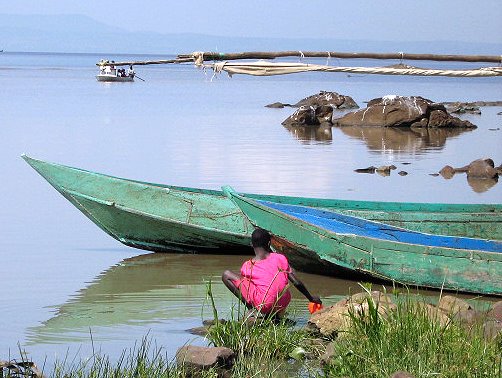 here is a view of one of the bays in lake victoria. it is such a huge lake that you can only see a tiny portion of it standing on the bank. the dhows on the bank are still used by fishermen who fish for tilapia, which is abundant in the lake and one of the main foods in this area. lake victoria is only about 60 miles south of where i lived in kakamega.
 this is one of the tiny market stalls on our lane. there are many of them, they all sell only a few items each day. the little boy in the front right was adorable, he loved bob and ran to greet him everyday. he called bob muzungu of course and he was only about 15 months old and i think that was one of the only kiswahili words he knew
 these are some of the kids who live on the lane where i am currently living. the showed up every afternoon to greet us. in kenya, children as young as 18 months are taught to shake hands with adults and to respond "mzuri" when greeted. the also use the only english they know which is "how are you" the moms don't really take care of the younger kids. that responsibility is left to the little girls who are about 8 or 9 years and older.


 Here are some of my pictures from Kakamega. I didn't take as many this time because I came home so soon but I do plan on taking more in September and will continue adding to my blog when I return, so keep checking in.
After walking, the boda boda is the way to get around town. it costs 15 cents to go anywhere. there are about 2000 of these guys in Kakamega and competition for business is stiff
8/10/2006
Bob and I returned to Chico about 2 weeks ago. After I got sick the second time, we made hasty arrangements to come back and have my health checked out by my doctors. It was an especially long trip because we had to fly standby. On Wednesday, it took the entire day to ride the bus from Kakamega to Nairobi, where we had to spend another day before we could get a flight to London. In London, we spent the night and then got a flight to San Francisco where we arrived at 9:00 pm. Being too tired to drive to Chico, we spent the night, and then drove home the next day. In total it the trip took 5 days!
It has been a reverse culture shock adjustment. Besides being in my own home, with my husband and being able to talk to all my family any time I want, one of the things I have enjoyed having again the most is the FOOD. African food is very filling and healthy, but it is bland bland bland and everything tastes the same. The food here tastes so great and I have been eating everything from pizza to enchiladas to steak.
However, aside from those things, there are actually many things I am missing about Kenya. The biggest one is the socializing with the community during my day. It feels like I am much less connected with people here and that the community is actually just a big collection of strangers. I think that is because as Americans we don’t really interact with strangers as we go about our daily business and as a result, in spite of the fact that there are people around us, we are still somewhat isolated from them. Whereas in Kenya, as in many other countries, it is expected that you interact with people you come in contact with and that generates constant socializing with people all day and really strengthens the sense of belonging to the community.
Also, in spite of the fact that that Kakamega, like many towns in third world countries, is very poor and has a lot of uncollected garbage, crumbling buildings, dirt streets and very basic, rural houses, I found that after living there, I was looking past all that and instead, I only saw the people. It always amazed me that the people were so happy living in what we would consider appalling living conditions as long as they had their families and food to eat. Now that I am home in California, everything seems sanitized, glossed over and homogenous, like it is a movie set or pictures of a town in a book, where real people don’t actually live.
Now that I have resolved my health issues, I have made arrangements to go back to Kakamega for about a month. I really want to finish the business training materials that I had been working on and feel very committed to accomplishing my goals. I know my work is just a tiny drop of water in the ocean, but having left something tangible there is very important to me.
7/24/06
Damn, damn, damn I got sick again last week. One day last week I went to a village outside of Kakamega called Labao to visit a polytechnic school and to take pictures for writing a possible grant program. While I was there I started to feel very sick again. So after getting back into Kakamega, Bob from the office took me directly to aga kahn hospital in Kisumu. When I got there I was feeling pretty seriously bad again. it turned out to be e coli in my kidney. The first night in the hospital I was in the maternity ward because there were no private rooms available. in the morning, I could hear a woman next door in labor and then shortly thereafter I could hear the baby cry. it was a wonderful sound. that night, after being transferred to the honeymoon suite in the private ward, someone died in the ward and then I could hear grief filled wailing, followed by the Muslim call for prayer from outside my window. Man, what a powerful reminder of the cycle of life.
Damn, damn, damn I got sick again last week. One day last week I went to a village outside of Kakamega called Labao to visit a polytechnic school and to take pictures for writing a possible grant program. While I was there I started to feel very sick again. So after getting back into Kakamega, Bob from the office took me directly to aga kahn hospital in Kisumu. When I got there I was feeling pretty seriously bad again. it turned out to be e coli in my kidney. The first night in the hospital I was in the maternity ward because there were no private rooms available. in the morning, I could hear a woman next door in labor and then shortly thereafter I could hear the baby cry. it was a wonderful sound. that night, after being transferred to the honeymoon suite in the private ward, someone died in the ward and then I could hear grief filled wailing, followed by the Muslim call for prayer from outside my window. Man, what a powerful reminder of the cycle of life.
Saturday, July 08, 2006
7/6/06
Its been a tough couple of weeks in Kenya. I’m not even sure if the date I wrote is correct. Anyway, I guess no long term trip to equatorial Africa is totally complete without a case of malaria. Apparently it is peak season for malaria here and many people are sick. The Kenyans of course are quite accustomed to having malaria and treat it pretty much like we do flu season. Apparently, the anti malarial medicine we take when we come here is just designed to kill the malaria plasmodium that is delivered when you are bitten by a mosquito. The only real defense from getting malaria is to not get bit and to hope like hell that your anti malaria medicine is working effectively. When the Kenyans sense they are getting another spell they are prescribed other types of malaria medicine and antibiotics that fights the bronchitis that almost always accompanies it. Anyway, for the Kenyans the spells usually last only a few days, but of course for us muzungus, it is a different story.
I got sick with malaria really quickly. The worst symptoms are the aches in the joints and the headache that makes you want to shoot yourself. I went to our best rural hospital for treatment and have only hazy memories of the 2 days I was there. I remember being admitted to the hospital and laying in the waiting room burning up with fever and watching two young girls fill out every line of several forms that took about an hour. The initial treatment was an iv of quinine which is a really potent medication. The iv holder hung on a nail on the wall. I don’t think the toilet worked and at one point, something very big and hairy darted out from behind the toilet and ran up the wall. Once in a while I would have two very young serious looking doctors standing at my bedside. They looked like mutt and jeff and didn’t inspire a lot of confidence. I was really sick for those two days and was only getting the doses of quinine and no intervenous fluids so I could tell I was getting dangerously dehydrated. Thanks to my wonderful husband advocating for me from 12000 miles away, I finally arranged a taxi to take me to the much bigger Aga Kahn hospital in the nearby city of Kisumu. It is a totally modern and technologically equipped hospital and when I arrived there the nurse said “don’t worry, you are in safe hand now” anyway, I got wonderful care there during the four days I was there but it was so odd being in such a place. I felt so isolated from the world that I could have been on the space station. So, now I am back in kakamega and reminded of the old saying “that which does not kill you makes you stronger” Bob is arriving in Kakamega on Thursday. It was hard for him to be the one so many miles away and helpless to do anything. He is going to stay with me in Kakamega for about 6 weeks and then we are heading home together. I am disappointed like crazy that I have to cut my stay short here, but I totally understand Bob’s desire to have me safe and sound in Chico again and I know I would feel exactly the same if it had been me at home. While Bob is here we are going to live in a small apartment in a compound just outside of kakamega. It is pretty darn nice by Kenyan standards, even has mostly running water and a sit down pot. The only real drawback I can see is the three cows that live in the courtyard and contribute a lot of cow poopy to the yard. However, owning cows in Kenya is a sign of great wealth so as they say, cow poopy really smells like money.
However, I am still working hard for the next six weeks to find a way again to help the clients we are serving. I vacillate between feeling like there maybe a way for all these programs to help Kenya fight the AIDs and poverty that is the standard of life here and then I am overcome by the truly helpless feeling knowing that these are such big problems that our only option is to put bandages here and there as best we can. I can’t imagine that all of us that are here from the west don’t wonder each and everyday how in the hell were we so lucky to been born into such a prosperous and promising society when so much of the rest of the world are simply about survival. The other 10 college age interns have arrived in Kakamega, full of the desire to make a difference. It is really wonderful getting to know these kids, they are pretty much highly ambitious kids from top colleges in the US. Watching them take the risks at assimilating themselves into this totally different culture is very interesting. I’m certain that after a couple of months here in Kenya the way they look at their own world will be greatly changed. I hope that like a stone thrown into a lake, what they take home with them will ripple out to the people that they associate with so those of us who do live in such fortunate circumstances will continue to be aware of the state of the world and to care about it.
Monday, June 19, 2006
6/16/06
In the street below my office, I heard a big crash followed by a wave of human commotion. When I looked down on the street, I could see that a car had hit a boda boda driver. This is hardly surprising, given the facts that cars have the supreme right of way over everything that is in the road and they drive extremely fast as well. A large crowd of boda boda drivers and other concerned onlookers gathered very quickly around the errant driver’s car. Many of the men were outraged and were simultaneously shouting accusations at the driver. The driver looked very nervous, and at one point started to drive away, but several of the men stood in front of the car, blocking his escape path. He finally got up the nerve to get out of the car, and when he emerged, there was some halfhearted pushing, shoving, and a lot of finger pointing by the boda boda supporters. Shortly, a helmeted, uniformed policeman drove slowly up on his small motorcycle. The men all took a quick break to admire the policeman’s piki piki, which obviously endowed him with a lot of status. I could see the policeman was a very young man as he slowly got off his piki piki and walked somewhat reluctantly toward the rowdy crowd. His demeanor didn’t convey a sense that he was about to take charge of the situation. Once he got to the crowd he paused to listen while several people shouted explanations at him all at the same time. The driver of the car didn’t have any obvious supporters present, but the policeman did question him apparently in an attempt to get his side of the story. Once that was accomplished, the policeman joined the crowd, which aimlessly milled around, all the while shouting out their opinion of what had transpired. Finally the policeman broke away from the crowd and went to choose an appropriate stone which he used some how mark the position of the car on the pavement. From my vantage point, I could not see that any marks were made at all by the stone. Then the guy strolled over and looked at the position of the boda boda lying on the ground. People were still shouting feverishly and I could not really tell at this point who the boda boda victim was. Finally, the policeman waved the driver of the car away, mounted his motorcylcle and left what apparently was a situation successfully resolved. I thought what a perfect solution since no one was really hurt and no damage was sustained. Just let everybody shout for a while and then call it good.
Tuesday, June 13, 2006
the big trip to Eldoret-on the edge of the Rift Valley
I wanted to share some stories about my trip to Eldoret with you..
This weekend I visited Eldoret with my colleague from work, Bernard Chegge.
On the way to Eldoret, as we approached the Ugandan border there were several police checkpoints I guess patrolling for drugs being smuggled in. in any event, one of the hotshot young police guys stopped our matatu and requested to see my passport which I didn’t have with me because we were only going 100 kilometres from Kakamega. Everyone in the van was very quiet while I was talking to the guy and after apologizing and swearing I wouldn’t leave it at home again, he let us go. I think it was all a farce and an attempt to get some money from me but for a second I was visualizing myself in some kenayn prison.
After we arrived, I spent pretty much all of Saturday meeting my colleagues huge family, including all of his brothers and sisters, cousins, in laws and what have you. They were all very welcoming but there was a family crisis. One of Bernard’s sisters and her husband were having serious marital problems and in Kenya the whole family is involved in the problem, listening to the couple and giving advice and most importantly, lobbying to keep the couple together. The presevation of marriage is a family affair here because in Kenya, when a couple gets married there is a symbolic payment of a dowry which is given to actually validate the bond that must be formed between each person’s clan. In fact, it appears that the formation of this bond is actually more important than the wedding preparations and especially more important that the happiness of the marriage. As a result of all this family pressure, you can imagine that the divorce rate in Kenya is pretty low but on the other hand, infidelity for both partners is common. Once again, another reason that AIDS is continuing to spread in Africa. It was quite a learning experience to watch all of this taking place as an outsider and it was hard to imagine all of it taking place in the US.
The town of Eldoret is considerably more modern than Kakamega and by visiting I was really able to understand how small and remoteI am here. First of all, there were lots of women of all ages wearing pants in Eldoret. Only women who are loose or doing commercial sex work wear pants in Kakamega. On Sunday there were lots of couples and parents with their kids doing things in the town. You never see a man and a woman walking togethe or doing any sort of activity together here. So, as a result of Kakamega being so rural, the norms are very conservative and there people are very concerned about what others may say about them.
The Rift Valley is very breathtaking. It is a lush green narrow valley with farms sprinkled throughout. And of course, there are bluffs on either side of it with lots of small rock faces and huge boulders. The Rift Valley separates Western and Eastern Kenya and of course is believed to be where human civilization began. Now, there is a great deal of civilization. There is a beautiful resort type place on one of the bluffs where the Kenyan running team stay and train. I am not sure what the elevation is but it is apparently high enough to be a good training spot. I actually got to eat a pizza when I visited Eldoret and it was good. It was bacon, mushroom and pineapple. After having been in Kenya for a month, it sure tasted good.
After we returned to Kakamega on Sunday evening, I don’t know if it was the full moon or what. But as I was walking past an area where all the boda boda guys wait for business, there was a big group of guys beating up a couple of other guys who must have infringed on their territory. Then, when I got into the matatu to go to my house, there were six older people sitting behind me screaming at the conductor about how they were overcharged. They continued to shout at him for about 5 minutes, it was not very relaxing in the least. It was a relief to get back to my house and when I did, the little girls came running to the door to see me saying they had missed me all weekend.
One other comment on the mitumba used clothes that everyone wears here;
Because a majority of the clothes come from the US, I have seen t-shirts and jackets with all kinds of sports teams names on them, including high school, college and pro sports from all over the US. I saw some college’s lacross jersey today. Seeing the t-shirts is a daily reminder of the fact that life is continuing as usual back in the US even though I am living here in such a different culture and environment.
Saturday, June 03, 2006
6/2/06
Hi everybody. here is the latest edition. i haven't been able to get photos on the blog. i think all of these computers have a 286 processor and have the tiniest dial up phone line in the entire world. i guess i will have to bore you with the photos when i get home.
I faced one of my fears today . After work, I walked around a little more of Kakamega’s off the beaten path streets without being accompanied by anyone. All Kenyans seem to feel like they are vulnerable to theft. I am constantly warned to be careful with my bag, in all the small stores the merchandise is kept behind a counter that is lined with steel bars, and everyone locks everthing they have with huge heavy duty locks. In a country this poor, people who don’t have anything will take big risks to find a way to eat.
The main streets of Kakamega which I call streets 1, 2, and 3 are fairly prosperous. Once in the back lanes however, you can really see the poverty that exists here. All of the buildings and little houses are in really bad condition and everywhere there are little children playing in the doors and lanes, wearing ragged clothes. They all stare at me intently and are very shy when I say hello to them.
On my stroll, I walked past 10 or 15 women selling a variety of things along the road. I greeted them all in Kiluhya and they just thought that was so funny and wonderful. the older women don’t speak much Kiswahili and are really pleased if you can speak the tiniest bit of Kiluhya.
I would say that there are two things that Kenyans are obsessed with and that is soccer and politics. As far as soccer goes, all the local teams are very popular and the match scores are reported on the nightly news. However, the English premier league is the real focus and it seems like everyone is in some way proclaiming their loyalty to Arsenal. In addition to Arsenal stickers, all the matatus are named and the majority of them also are covered with Christian slogans. I would say that these crazy drivers definitely need god watching over them while they careen down the road.
The missionaries have been very effective in Kakamega. There are an overwhelming number of churches and mosques here. The religions represented are primarily catholic and Quaker, but there are other sects like the Anglican Church, some evangelical churches, and other types of protestant churches. When traveling in the rural areas outside of Kakamega, there are churches and schools approximately every 5 miles. The other impact that Christianity has had on the Kenyans, which I am sure that the missionaries didn’t anticipate, was in people naming their businesses. There are many small shops in and around Kakamega and many have names like Christian guest house, faith clothing shop, hope supermarket, and trinity bike repair. Since the Kenyans have struggled so long for freedom and against extreme poverty, they have developed a deep faith and belief that it is God who will help to miraculously help to improve their condition. Over the last 40 years the majority of Kenyans have all come to rely almost solely on foreign aid and grants from western countries. They have no faith in their government and leaders to take a strong role in helping develop the infrastructure and economies in rural Kenya where the poverty exists. As a result, the widespread attitude shared by many poor Kenyans is there are no opportunities for them to help themselves to improve their lives. so they rely on God to help them survive and cope with their difficult circumstances.
I enjoy regularly reading the Nation, one of Kenya’s two national newspapers. The government controls the news here but there are still stories about the current political scandals balanced with stories reporting on the positive outcomes of newly implemented government legislation and programs. This weekend, the front-page story published a list of the top 25 corrupt bribe taking government agencies. The 5 top agencies were the police, state corporations, local authorities, the teacher’s service commission, and the Kenya prison system. The highest average bribes were paid to public colleges for admissions. The bribe paid was equivalent to about $2000 US .The police were the second highest with a likelihood of bribes being 82%.
Subscribe to:
Posts (Atom)